It depends on your solar billing program. On PG&E's Solar Billing Plan (also called NEM 3), E-ELEC is required. On NEM 2 (Net Energy Metering 2) you choose among the time-of-use plans you qualify for, and an EV or an approved battery of minimum size qualifies you for E-ELEC, so compare them with your own usage.
Do I have to be on E-ELEC with the Solar Billing Plan?
Yes. Residential customers on PG&E's Solar Billing Plan, the Net Billing Tariff for systems that applied after April 14, 2023 (and for older systems whose net-metering term has ended), are enrolled in E-ELEC and must stay on it; no EV, battery or heat pump is needed for them.
Source: PG&E E-ELEC tariff, sheet effective 2026-08-28; PG&E Solar Billing Plan
Which plans can NEM 2 customers choose?
NEM 2 requires a time-of-use rate, so the tiered plan E-1 is not an option for NEM 2 homes. They choose among the time-of-use plans they qualify for: E-TOU-C, E-TOU-D, and EV2-A or E-ELEC with an EV, a heat pump or an approved battery of at least the minimum size.
The best choice depends on when your home imports from the grid, since exports and imports are priced by the hour.
Why do I still owe PG&E at true-up?
Because solar credits offset energy charges, not every charge. Solar customers still pay the Base Services Charge and the non-bypassable charges (Public Purpose Programs, Nuclear Decommissioning, Competition Transition Charge and the Wildfire Fund Charge), and export credits cannot reduce them.
PG&E bills these on the electricity you take from the grid, interval by interval. Under the Solar Billing Plan, energy you export is credited at values that vary by hour, day and season, so exports at low-value times earn less than the energy you import at 4 to 9 pm costs.
- Check when you export and when you import.
- Check whether another eligible plan would have priced your imports lower.
Your true-up settles at the end of each 12-month billing cycle, which starts on the date PG&E approved your system to operate. For some customers the first cycle is shorter than a year.
Does a Powerwall change the best plan?
A battery can change the best plan. One that stores daytime solar for use from 4 to 9 pm lowers your most expensive imports, and an approved battery of at least the minimum size makes a NEM 2 household eligible for E-ELEC (PG&E E-ELEC tariff, sheet effective 2026-08-28).
Whether that beats your current plan depends on your usage; for NEM 2 homes, the app models one or two Powerwalls on your own data.
Frequently asked questions about solar rate plans
Can I change my rate plan after installing solar?
Yes, within PG&E's rules. Solar Billing Plan customers stay on E-ELEC; NEM 2 customers choose among the time-of-use plans they qualify for. PG&E limits how many times you can change plans in a year. Ask PG&E whether a plan change affects your true-up date before you switch.
How long are Solar Billing Plan export credit values locked?
Nine years from the date PG&E approves the system to operate, for homes whose interconnection application was completed between April 15, 2023 and December 31, 2027 (PG&E's tariff). After that the credits follow current PG&E average values.
Homes that enroll after 2027 do not get the nine-year lock. A separate Energy Export Bonus Credit, available to early adopters, is also fixed for nine years.
Does WattPayoff work with solar?
How does WattPayoff help solar homes?
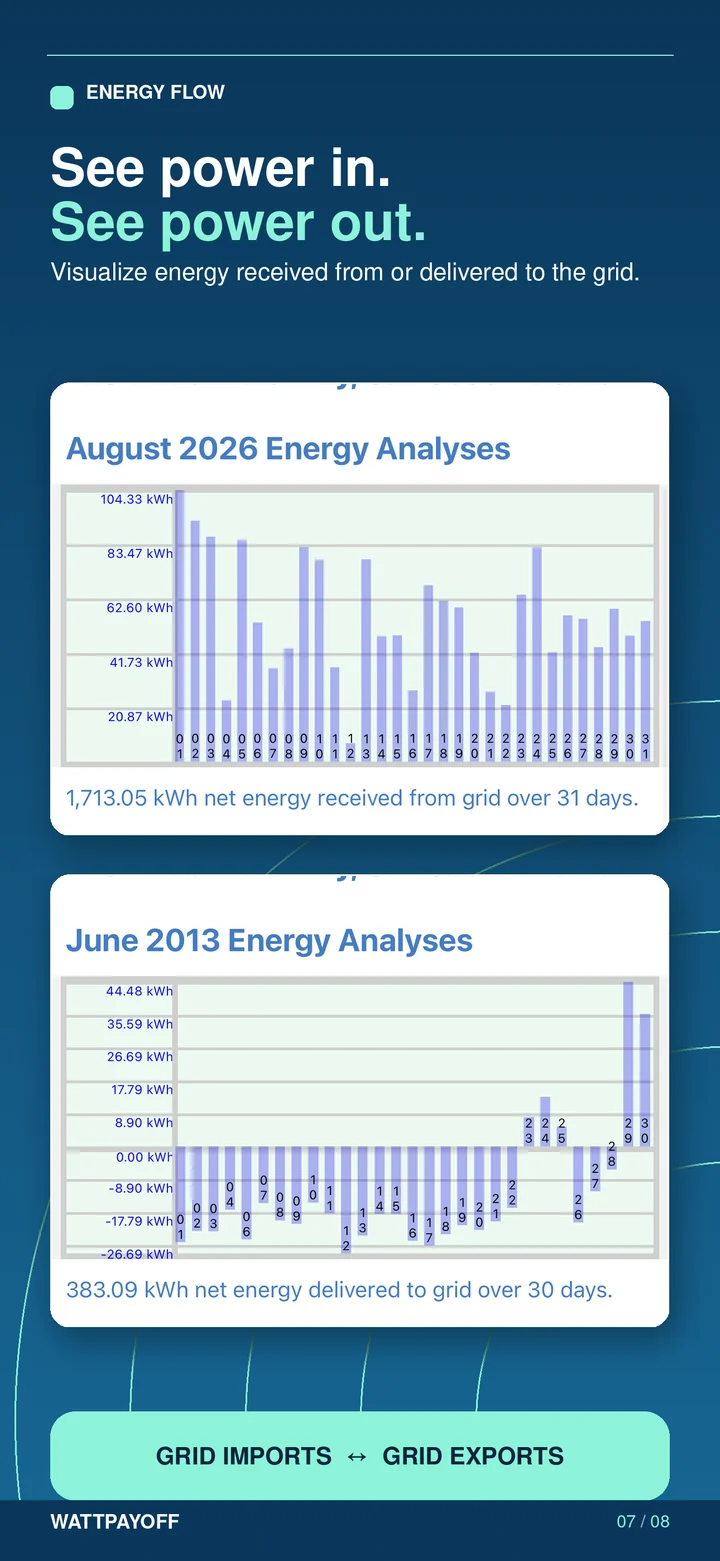
WattPayoff shows the energy you take from and send to the grid and models one or two Powerwalls, using your PG&E meter data. What it supports today is on the solar grid flow page.