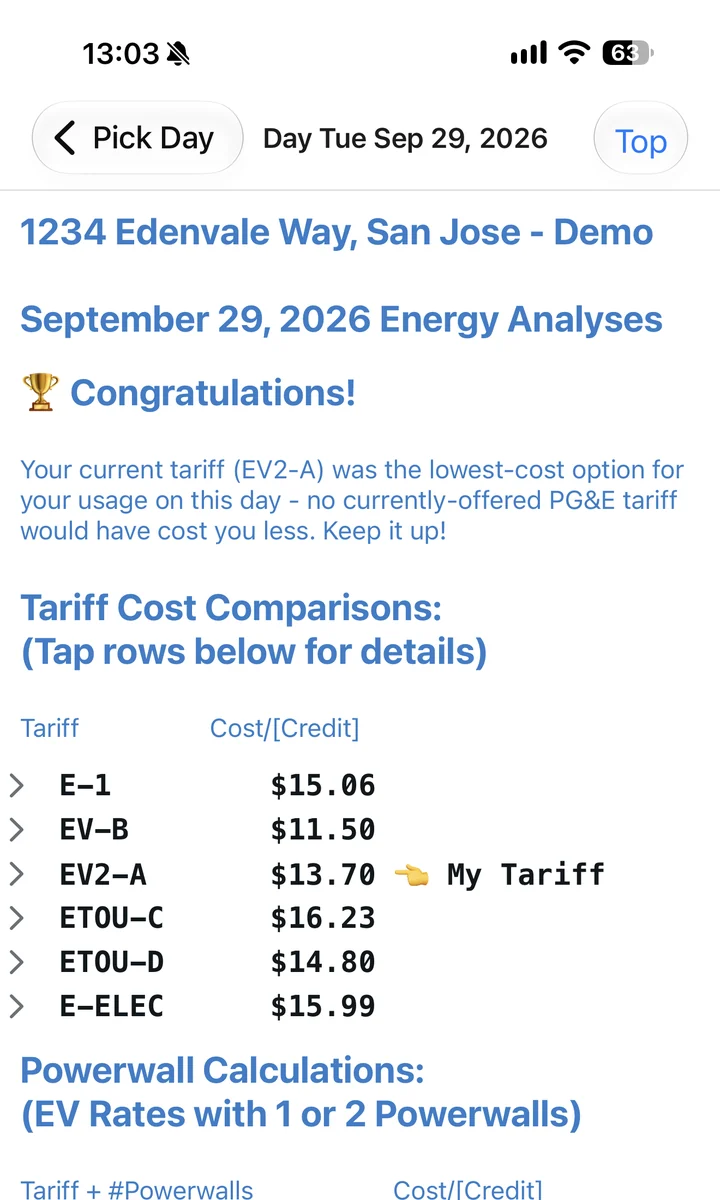
For a home that charges overnight, EV2-A usually has the lowest charging price: 22.558¢ per kWh from midnight to 3 pm, year-round. But EV2-A costs more than E-ELEC from 3 pm to midnight in winter, and E-TOU-C keeps a baseline credit, so the cheapest plan depends on your whole home's usage, not just the car.
Rate comparisons show what different plans would have cost for past usage. Rate eligibility and future savings may vary.
What are PG&E's EV-friendly rate plans and their hours?
Four PG&E residential plans matter for EV owners, and three of them charge most from 4 to 9 pm. For E-TOU-C, E-ELEC and EV2-A, summer runs June 1 to September 30 and winter October 1 to May 31. EV-B uses May 1 to October 31 and November 1 to April 30.
- E-TOU-C: peak 4–9 pm every day; off-peak all other hours; a baseline credit on usage within your baseline allowance.
- E-ELEC: peak 4–9 pm; part-peak 3–4 pm and 9 pm–midnight; off-peak midnight–3 pm, every day.
- EV2-A: the same hours as E-ELEC.
- EV-B: a separately metered charger. Weekdays (Monday to Friday, except holidays): peak 2–9 pm, part-peak 7 am–2 pm and 9–11 pm, off-peak 11 pm–7 am. Saturdays, Sundays and holidays: peak 3–7 pm, off-peak all other hours. Holidays are New Year's Day, Presidents' Day, Memorial Day, Independence Day, Labor Day, Veterans Day, Thanksgiving Day and Christmas Day.
How do the 2026 prices compare?
Per kWh. E-TOU-C, E-ELEC and EV2-A: PG&E tariffs effective 2026-06-01. EV-B: PG&E tariff effective 2026-03-01.
| Plan | Summer peak / part-peak / off-peak | Winter peak / part-peak / off-peak |
|---|---|---|
| E-TOU-C | 52.240¢ / — / 39.940¢ (minus 8.140¢ baseline credit) | 39.757¢ / — / 36.757¢ (credit applies) |
| E-ELEC | 55.214¢ / 39.026¢ / 33.358¢ | 32.063¢ / 29.854¢ / 28.468¢ |
| EV2-A | 53.809¢ / 42.760¢ / 22.558¢ | 41.099¢ / 39.428¢ / 22.558¢ |
| EV-B (EV meter) | 62.131¢ / 37.720¢ / 26.465¢ | 43.878¢ / 30.677¢ / 23.504¢ |
Is EV2-A or E-ELEC cheaper after the 2026 changes?
EV2-A is cheaper for overnight charging; E-ELEC is cheaper from 3 pm to midnight in winter. EV2-A's off-peak price is 22.558¢ against E-ELEC's 33.358¢ in summer and 28.468¢ in winter, but in winter EV2-A's peak (41.099¢) and part-peak (39.428¢) are well above E-ELEC's (32.063¢ and 29.854¢).
- A home whose usage is mostly overnight charging: EV2-A tends to win.
- A home with heavy evening or winter-daytime use: E-ELEC can win.
Only your own hourly usage settles it.
Is EV2-A worth it, or should I stay on E-TOU-C?
EV2-A is worth it when the overnight savings on charging outweigh higher prices at 3 pm to midnight and losing E-TOU-C's baseline credit. Afternoon air conditioning, cooking and laundry between 4 and 9 pm cost 53.809¢ on EV2-A in summer, against E-TOU-C's 52.240¢ less its 8.140¢ credit for usage within baseline, so a busy-evening household can pay more.
- Check: how much of your usage falls midnight to 3 pm, and how much 3 pm to midnight.
- Check: how much of your usage is within your baseline allowance.
Then compare a full year, and check when you last changed plans, because PG&E limits how often you can change plans in a year.
Who can use each plan?
- E-TOU-C, E-TOU-D, E-1: any residential customer.
- EV2-A: households with a registered plug-in electric vehicle, or battery storage, or an electric heat pump used as the main way to heat water or heat and cool the home (PG&E tariff Schedule EV2; PG&E's EV rate plans page). Battery-only enrollment is a limited pilot capped at 30,000 customers, and the battery must be approved to operate and meet a minimum size.
- E-ELEC: households with an EV, an electric heat pump, or battery storage (a battery approved to operate and of at least the minimum size); required for solar customers on the Solar Billing Plan.
- EV-B: a separately metered EV charger.
- On EV2-A and EV-B, if your household's total use over the last 12 months exceeds 800% of your annual baseline allowance, PG&E moves you to E-TOU-D and you can't use an EV rate (EV2-A or EV-B) for 12 months. E-ELEC and other plans you qualify for stay open, and the rule does not apply to E-ELEC.
- WattPayoff prices these plans from your usage but doesn't check whether you qualify; confirm eligibility with PG&E before switching.
Frequently asked questions about EV rate plans
Short answers to what EV owners ask next.
What's the cheapest time to charge an EV on PG&E?
Midnight to 3 pm on EV2-A and E-ELEC. On EV-B, 11 pm to 7 am on weekdays, and on weekends and holidays any time except 3 to 7 pm. On E-TOU-C, any time outside 4 to 9 pm is off-peak.
Does EV2-A have a baseline credit?
No. EV2-A has no baseline allowance credit; E-TOU-C does.
Are weekends cheaper on PG&E?
Yes, on two plans. E-TOU-D's 5–8 pm peak applies on non-holiday weekdays only, and EV-B's weekend and holiday peak is 3–7 pm. E-TOU-C, E-ELEC and EV2-A use the same hours every day.
Can I switch to EV2-A the day my EV arrives?
You can request it, but PG&E limits how often you can change plans in a year, so check when you last switched and time it well. PG&E's Help Center says a significant change in how you use energy, such as buying an EV, may allow PG&E to reevaluate.
How does WattPayoff help EV owners choose?
WattPayoff prices your real usage, charging included, on each plan, and re-checks every month as your charging settles in.