
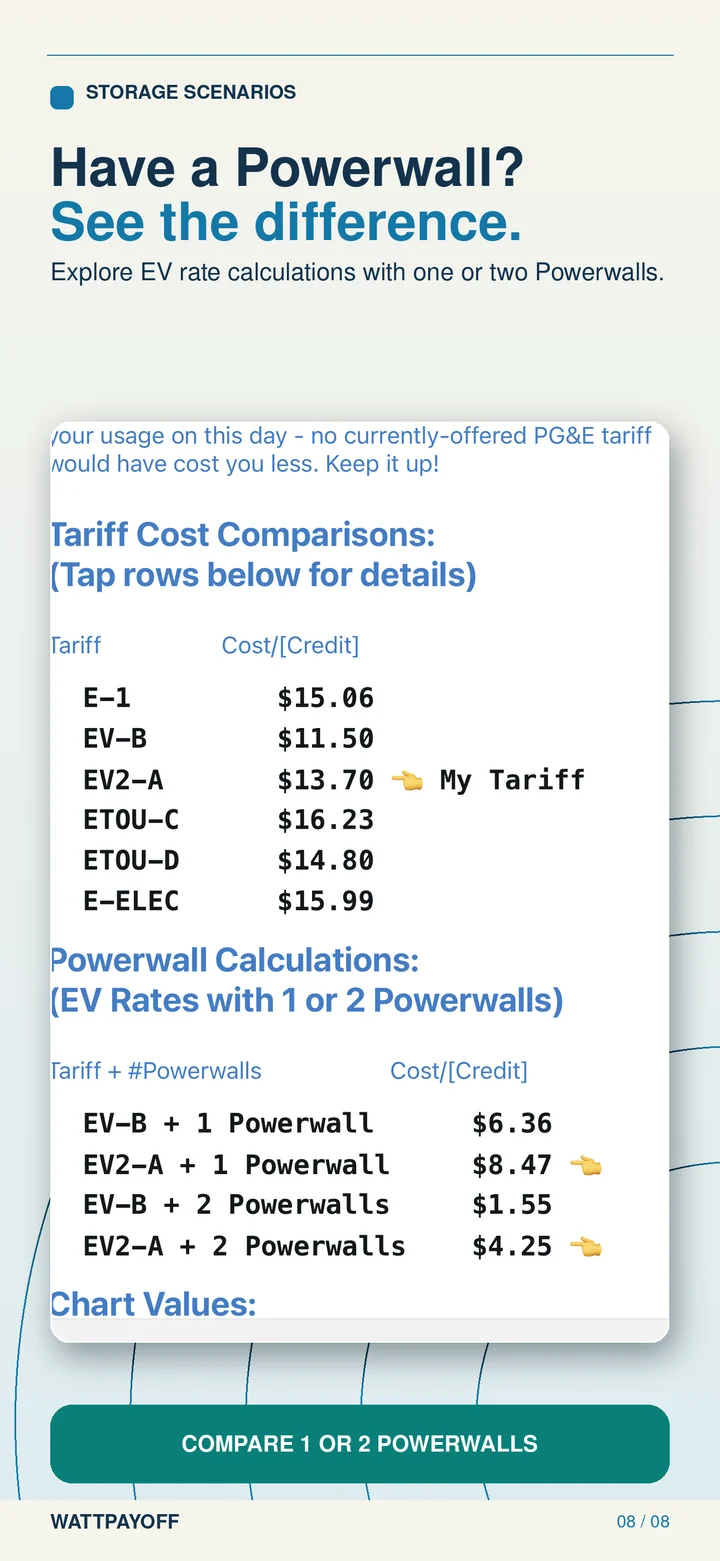
WattPayoff models your own PG&E usage with one or two Tesla Powerwalls on EV rate plans such as EV2-A and EV-B, and shows what each combination would have cost next to your current plan. It's a model of past usage, not a quote or a guarantee.
Rate comparisons show what different plans would have cost for past usage. Rate eligibility and future savings may vary.
Is a Powerwall worth it on PG&E?
Whether a Powerwall is worth it depends on your usage and your rate plan's peak and off-peak prices; savings alone rarely tell the whole story.
A battery saves money by covering expensive 4 to 9 pm usage with cheaper stored energy; many owners also buy one for backup power. The app shows the rate side of the decision with your own numbers.
- What the model includes: one or two Powerwalls, about 14 kWh each, assumed to fill and use most of their energy every day, to maximize savings.
- What it doesn't: purchase price, incentives, installation, or Solar Billing Plan (also called NEM 3) billing, which the app doesn't support yet.
Which PG&E rate plans can a home battery use?
A home battery qualifies a home for PG&E's E-ELEC plan if it is approved to operate and of at least the minimum size set in the tariff; an EV or a heat pump also qualifies. Homes on PG&E's Solar Billing Plan must be on E-ELEC. (PG&E E-ELEC tariff, sheet effective 2026-08-28.)
Which plan with solar or a Powerwall?
Frequently asked questions about Powerwall scenarios
Do I need a Powerwall to use this?
No. The scenarios model a Powerwall on your past usage, so you can see the rate effect before buying one.
Does it work with other home batteries?
No. The app models Tesla Powerwalls only, one or two of about 14 kWh each; it cannot model other home batteries.